
Tree Trail Part 4
The Lonely Tree - Rodborough Common

Stroud’s own “Lonely Tree” tumbled just a few months after the destruction of the more famous sycamore on Hadrian’s Wall. In its own way, the isolated beech — which had stood in the middle of Rodborough Common — prompted a community outpouring not dissimilar to its counterpart. Local commentators eulogised the significance of this tree in family life, as a waymark and as a beacon.
Spring walks are a muddle of promise and legacy. I set out across the common from the road, where the melodies of skylarks invigorate the landscape in every direction. I slither across grass grazed to a length that hides how sodden it is. I detour left and right to avoid the pools that have appeared overnight.
Posies of scrub — tiny pieces of rewilding just big enough for cattle to shelter in — are made up of hawthorn, holly, briar, and elder. Nearby, trees cultivated into a discernible hilltop clump mark humanity’s urge to create order.
The cloud that rested down in the valley overnight has almost been wisped away, but a few strands remain caught in the treetops — the moisture of soil and sky clinging together for a while longer. Shreds of children’s kites pollute the view across many of the taller trees — memories of ill-conceived afternoon playdates.
The Lonely Tree is laid out in a funereal pose. Storm Gerrit’s visit fractured some of its branches into pieces, but the apparent health of the upper quarters is striking. It is at the base of the trunk where its vulnerabilities are evident. Its core is hollowed out; the heartwood has all rotted away. A hollow that was once a source of gleeful discovery for children has become its downfall.
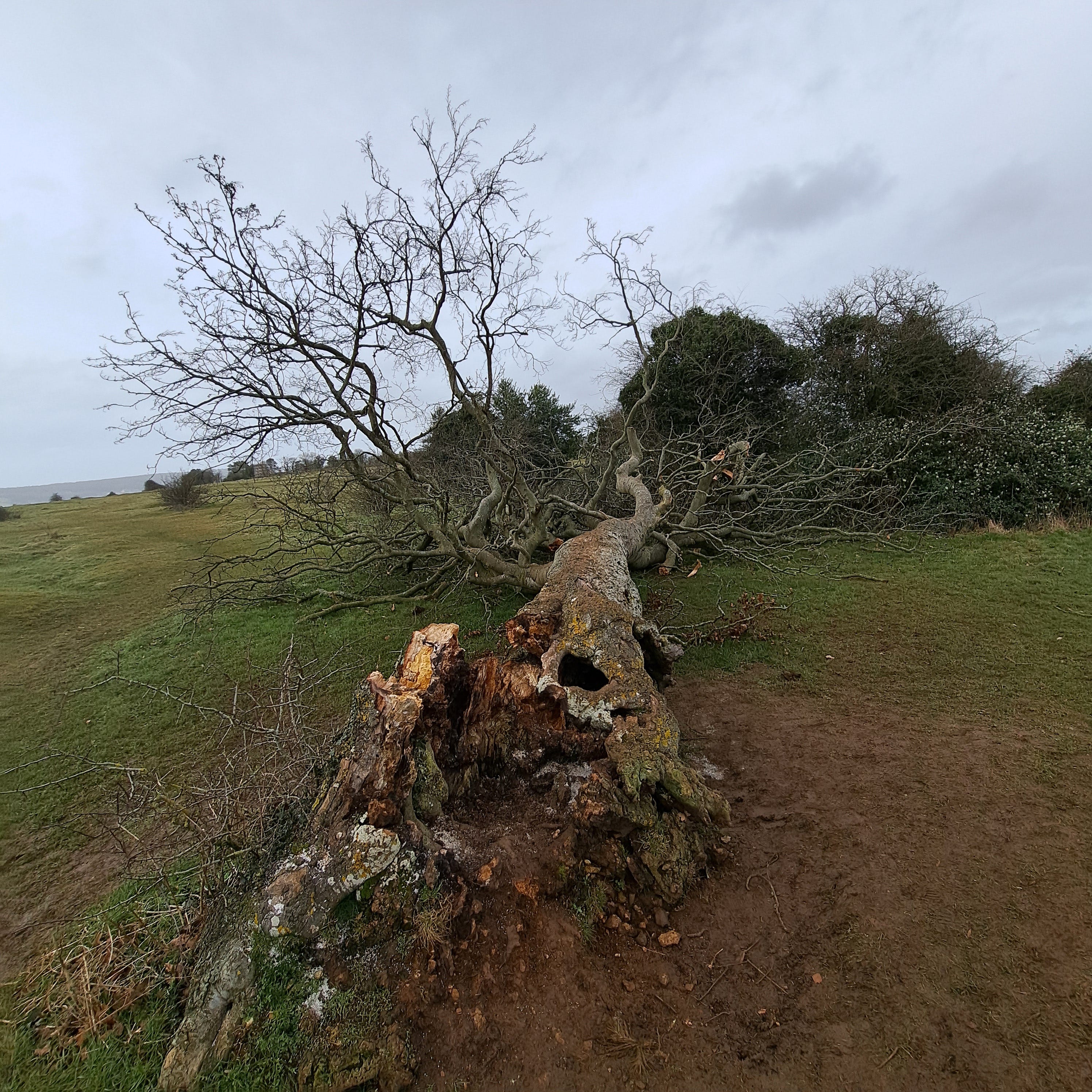
Where the root section and main stem have parted, there is evidence of considerable spalting. This chocolate-brown marking in the wood — caused by the tree’s reaction to a fungal infection — is much sought after by carpenters and bowl makers. Here, amongst the shattered fibres of wood, its presence is more menacing than beautiful.
Beech is a species of southern Britain. Pollen samples, archaeologically discovered, show how it made progress across the country after the last ice age, before the land bridge with Europe was submerged. Its qualities as firewood and in chair-making ensured its cultivation and management for centuries. As the great storm of 1987 showed, those trees left to grow to their full potential were predisposed to unsteadiness and yielded to the ferocity of the wind — often knocking over their neighbours in the process.
Most of the hills in this part of the Cotswolds — where they are too steep for arable production — have sections of beech growing on them. As a child, that is what I assumed all woodlands were like: silvery pillars pointing skywards, with the sputtering of the three-sided mast (nuts) beneath my feet.
The use of beeches as markers is common. They can be seen clustered into clumps on summits for miles around. It is a phenomenon that obsessed the artist Paul Nash, featuring centrally in many of his paintings.
The beech has a particular association with the literary world. It is thought that long-lost books may have been inscribed onto slices of its pale-coloured wood. In a slightly different collection of work, its smooth bark lent itself to practitioners of the ancient art of graffiti carving — a form of the craft which, unlike the painted version, doesn’t degrade over time. This led the Romans to record the proverb: “Crescunt illae, crescant amores” (“As these letters grow, so may our love”).
This tree — thanks to its location and unique qualities — inspired art and literature even before it toppled. It held particular significance for the author Katie Fforde, who in January 2024 launched a writing competition for words to immortalise the passing of what has become a local icon. The new work will add to a scattered canon, including the words committed to linocut by JLM Morton, concluding prophetically in 2020: “Let me walk barefoot on the lean of my trunk – give me a ladder to climb from this world to another.”