
Tree Trail - Part 3
The Snow Farm Ash

The “Snow Farm Ash” high in the Slad Valley, on the route of the Laurie Lee Wildlife Way is easy to miss. Positioned low on the bank with a jumble of scrub around it, its significance is not immediately apparent. The tree was the subject of a 2018 filming project, resulting in a feature which captures it throughout a whole twelve-month period.
There is no easy way to make a visit, good footwear, and an ability to cope with steep hills is required. I have made the walk out from the village approaching through the Gloucestershire Wildlife Trust reserve. Long before the tree is in sight, I am fascinated by bulging stands of ash, beech, and hazel. The breadth of these now unmanaged specimens gives some indication of their age and human relationship to this landscape. Where some have been cut and managed at ground level (coppiced), others were pollarded.
The narrow path creeps up the contours as I approach my tree. Another kestrel spotting me before I see it, abandons its sentry duty and beats off into the woodland. Recognising the tree from its film I can see that at some point it has been cultivated into a pollard, but the resulting limbs are now so huge this must have been midway through its 400-year life. Shaded boughs and trunk are inch thick in moss. Three limbs have been allowed to reach down to touch the soil, a phenomenon too often tidied away by human intervention. Here it is an essential dignity, providing help in old age
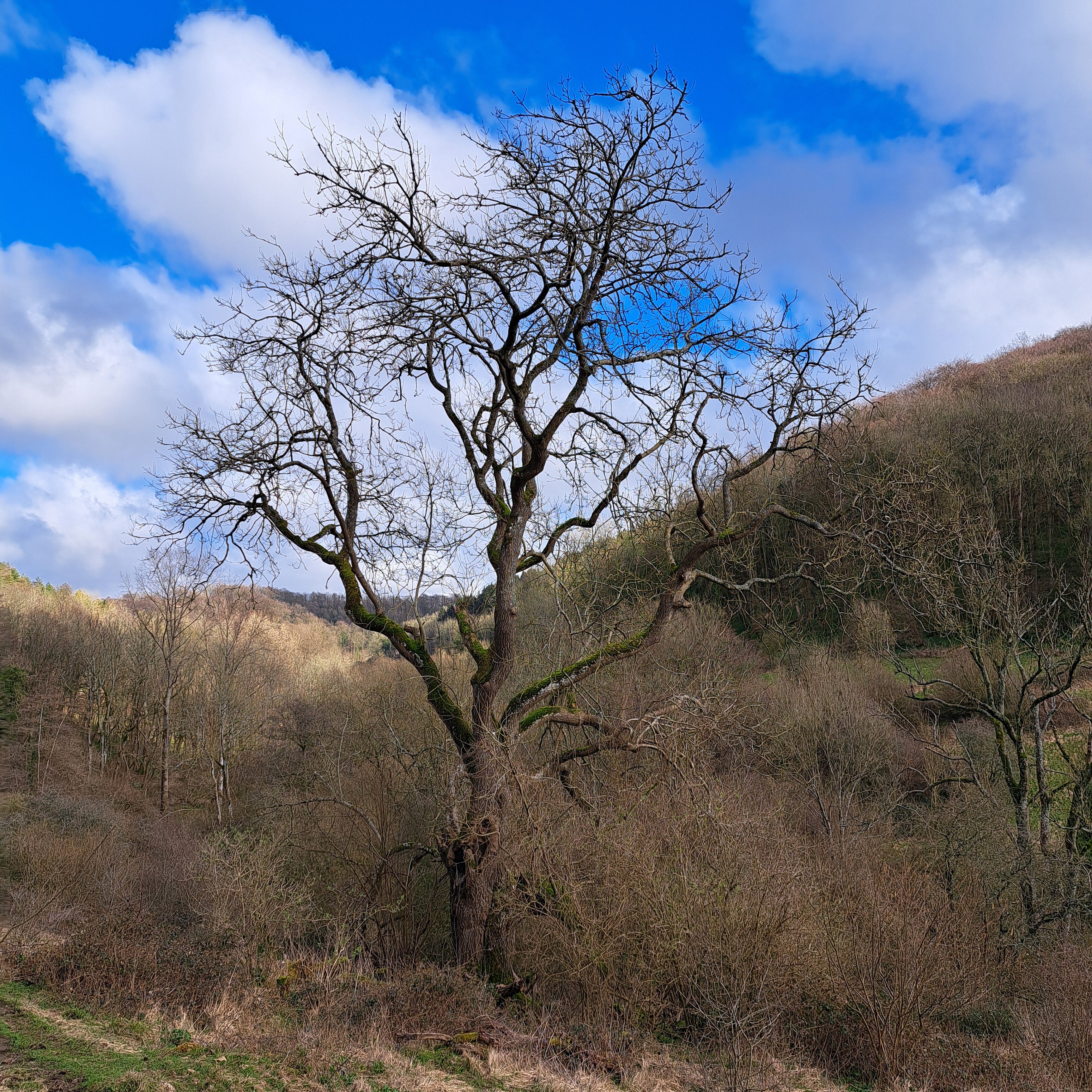
.
The presence of King Alfred’s cake fungi suggests that this is a tree giving way to the inevitability of death. The wood which has dropped to the ground around the base make it a scramble to get close, but the effort reveals rotted hollows which in season will be accommodating birds. A badger sett is scraped into the angle of the roots.
Close to here, the council and other landowners have been removing all ash trees from roadsides and woodlands in fear of the consequences of ash dieback disease. This fungal infection is predicted to alter the entire ecosystem of the UK. The interventions, in part to try and curtail the spread of the disease and partly to prevent injury (or worse) from falling timber, are estimated to be contributing to a total cost to the UK economy of £15 billion. Between 1-5% of trees may carry a natural resistance, we must hope that with the ash’s legendary ability to self-seed, its exclusion from our countryside will only be temporary. As woodworkers know, the unique lightness, flexibility and capacity for steam bending of this timber enable its usefulness in a range of products. In my own home, the fine blades of ladderback chairs, which look too thin to survive a family dining room, bear testimony to its durability.
The ash might not have any medicinal qualities, but it was once practice to try and heal an ailing child by passing them between the cleaved section of a trunk spilt for the purpose. The wood was then bound, the recovery of the tree (or not) was thought to run in parallel with the fate of the child. Given the fecundity of the species in the countryside it is perhaps not surprising that it became associated with life and healing.
The geography of Laurie Lee’s writing isn't always easy to pinpoint. This strip of valley doesn't have any obvious recording in his work. I lean into my walking pole to maintain grip on the seeping slope as the season makes its rotation through the seasons, recalling an observation during an earlier spring of a tree “sweating with the bead of summer in its bud”. Laurie Lee was not this tree’s nearest poet neighbour. For a while Frances Horovitz lived very close to this remote spot, contemplating mortality under a leafless tree with “raindrops glimmering in last light on black ash buds.”