
Tree Trail - Part 2
The Little Sodbury Yew

I have walked around the ancient hill fort above Little Sodbury several times, but I have never seen the ruined church and the “Little Sodbury Yew.” History vaporises from the sodden ground, wafting and soaking me as I walk along the spine of the Cotswolds. I spend more time stopped than I do moving. The clanking of swords, the clattering of pots and the whinnying of horses faintly echo in the dripping breeze. My mind jolts as I make sense of 200 generations of human experience.
On this high ground hedges have conceded to limestone stone walls which do not have any better description than U.A. Fanthorpe’s confining “the verges like yellow teeth.” She noted, from her home below here, that on these uplands the “trees look sideways.”
The path loops down through the woods below the fort parallel with a hollow way deeper than any other I know of. These ancient paths are common along the Cotswolds. Their depth maintained by the passing of feet, hooves and water, while the soil along their sides deepens with each fall of leaves. The scale of this one is so dramatic it is possible it might have been engineered as some sort of boundary, between the fort and the manor house just yards to the west.
I look down onto a damp, shaded, level area cut into the hill. Squeezed between the back of the manor house and the bank, early in the 16th century Sir John Walsh concluded there was room for a church. The economies of the setting meant that there was no chancel. Demolished and moved to a location elsewhere in the village, all that remains now is the archway of the south door, shrouded in dereliction by ivy.
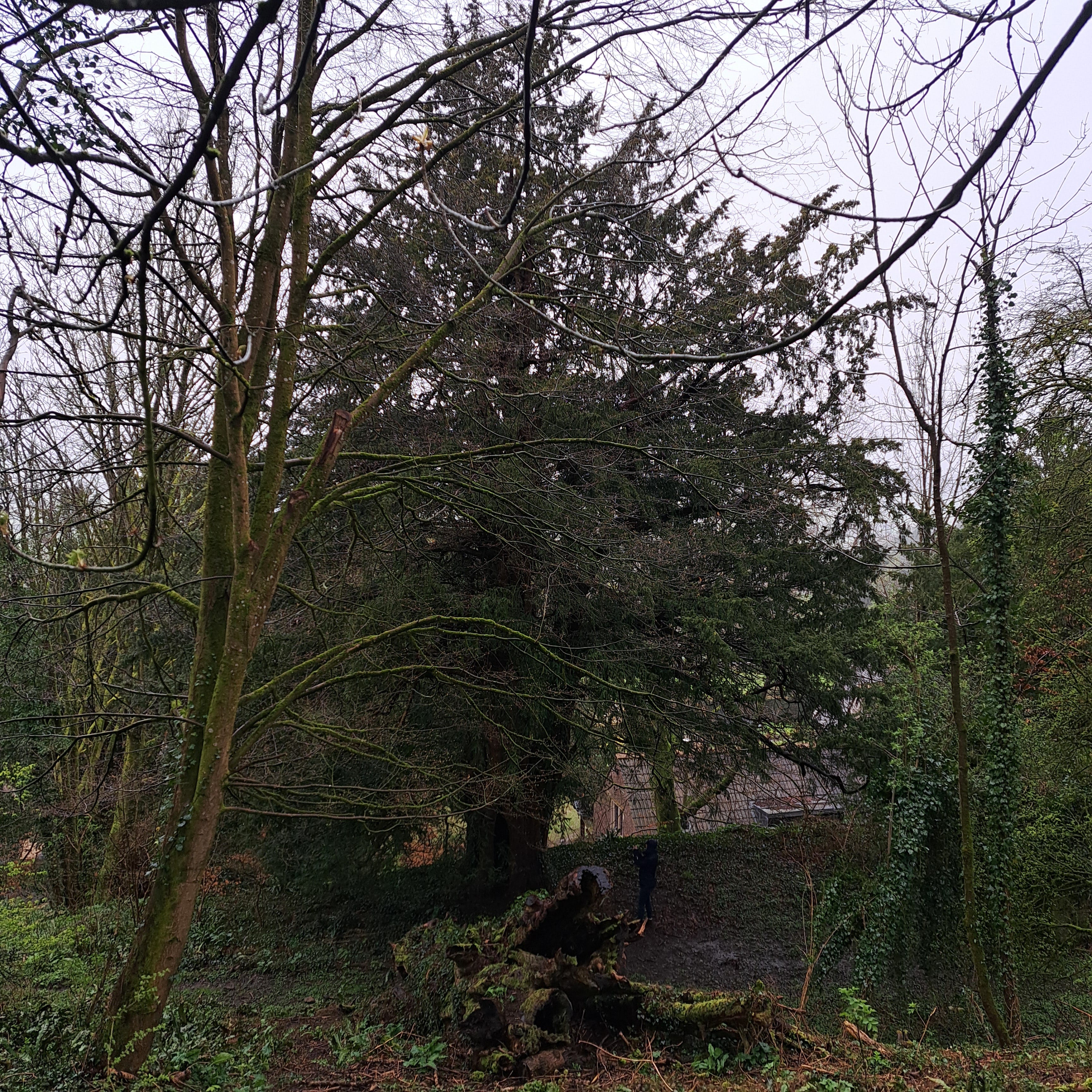
Two yews once stood guard either side of the entrance, only one remains vertical the other laid out where it fell. Estimated to date back as early as the 13th century, while no records survive to confirm it, it is likely this site had sacred value even before the lost church was built.
In 1522 the Walsh family employed a 28-year-old priest by the name of William Tyndale to act as tutor to the children of the house. His short tenure at little more than a year reflects some of the frenetic urgency of his life at the time. It was here, tradition has it, that he began the gruelling task of translating the bible into English. It would be easy to underestimate the potency of such an endeavour. His intention was not simply to enable people to hear stories more easily – he expected to disrupt the entire established power base of society. His most repeated quote from an argument with a learned person goes “I will cause a boy who drives a plough to know more of the scriptures than you do.”
Tyndale’s translation aligning with the invention of the printing press and the reformation underway in Europe, became the first of the ideological revolutions of history, from which many others can trace their lineage. He was executed at Vilvoorde in the Netherlands in 1536.
The tree stands taller and straighter than many. The reddish tan of the flaking bark indicates the colour of the wood beneath. Wood pigeons clatter out of the beeches, unnecessarily startled by a visitor. Songbirds are silently clamped to boughs, feathers puffed, waiting out the rain. A ladder of limbs is offered as a route towards the top. The heartwood has long since fallen away creating crevices and chasms for creatures of feather and fur.
The association between yew trees and English churches is the subject of much speculation. There is no definitive rationale for their placement. The theory that the trees were grown for the production of longbows and that they needed to be within the fenced environs of churchyards due to their toxicity has been discounted. Local yew was too brittle, meaning imported wood was used and the areas were often grazed regardless.
While there is evidence of yew fronds being used as “palms” on Palm Sunday and other decorative purposes, it is likely that that yews were thought to have some benefit associated with the dead. Perhaps, it was believed that they had a usefulness in purifying the earth and air of death. Another rationale is symbolic, their evergreen character pointing to resurrection and everlasting life. Either way, the fact that many ancient yews pre-date the churches on the same site suggest they were there for an earlier reason and these being local burial sites seems as good an explanation as any.
I make the climb up the hill towards the fort, the path turning to a spate in the intensifying rain. I ponder the immortality of the remaining Little Sodbury Yew and the greater immortality of the dissident priest who would have passed beneath it, making his way to and from worship, crafting sentences which were set to have as great an influence on the development of our language and culture as those of Shakespeare
.